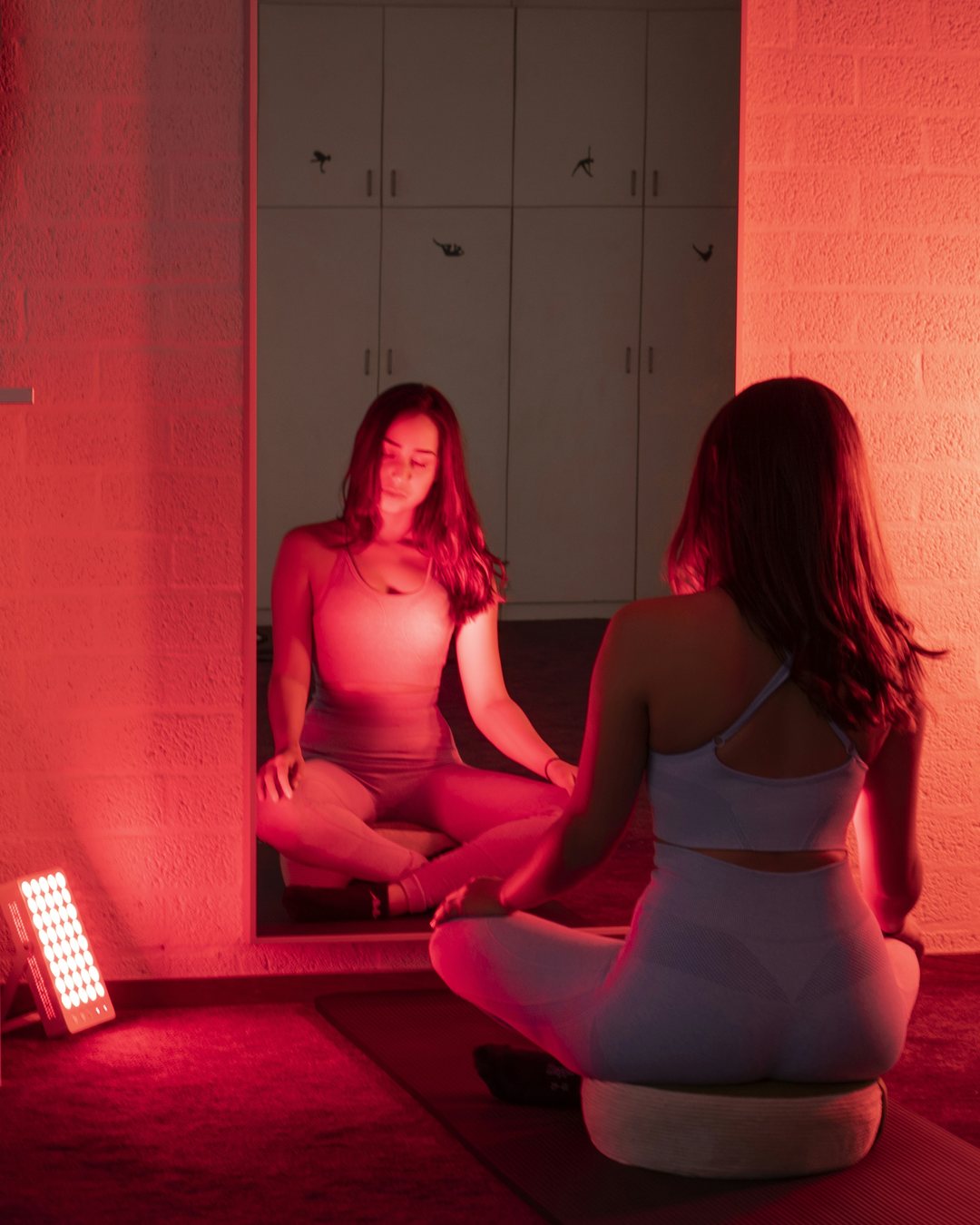
The start of the day, at home. Six morning practices, and what the research found.
Same wake time, seven days.
REM follows the body clock as well as time asleep. In a lab study of eight men, it ran highest when the end of sleep lined up with the usual wake time (Dijk and Czeisler, 1995).1
Outside light, in the morning.
A review found that morning light moves the body clock earlier, while evening and night light moves it later. Full daylight outdoors reaches about 25,000 lux, against roughly 500 for standard office lighting (Blume et al., 2019).2
An hour of moderate exercise, early.
In a lab study of 99 fit young and older adults, an hour of moderate treadmill exercise on three days in a row, at 7 a.m. or between 1 and 4 p.m., moved the body clock earlier; the same hour between 7 and 10 p.m. moved it later (Youngstedt et al., 2019).3
Red light, if you like. Goggles on.
The evidence is early and mixed: a 2025 review of whole-body red and near-infrared light found five small studies, 105 active adults in all; two reported better sleep, and none found a benefit for exercise performance or markers of fatigue (Álvarez-Martínez and Borden, 2025). Wear protective goggles, never stare into the LEDs, and follow the maker's instructions.4
Sauna, if you have one. Water after.
The research on regular dry sauna is mostly small: of 40 studies in one review, only 13 were randomized trials and most had fewer than 40 people. The largest, a cohort of 2,315 middle-aged Finnish men followed for about 20 years, linked four to seven saunas a week to a 40% lower death rate from any cause than once a week, an association, not proof (Hussain and Cohen, 2018).5
A cold finish, thirty to ninety seconds.
A 2025 meta-analysis found 11 trials: ten small studies of men only, and one of 3,018 adults, where ending a warm shower with 30 to 90 seconds of cold for a month cut self-reported sickness absence from work by 29%, though not the days people were ill (Cain et al., 2025).6
The morning is yours. The rest, handled at your house.
Request a walkthroughSources
- 1. Dijk DJ, Czeisler CA, Contribution of the circadian pacemaker and the sleep homeostat to sleep propensity, sleep structure, electroencephalographic slow waves, and sleep spindle activity in humans. Journal of Neuroscience 15(5):3526-3538 (1995). https://doi.org/10.1523/JNEUROSCI.15-05-03526.1995
- 2. Blume C, Garbazza C, Spitschan M, Effects of light on human circadian rhythms, sleep and mood. Somnologie 23(3):147-156 (2019). https://doi.org/10.1007/s11818-019-00215-x
- 3. Youngstedt SD, Elliott JA, Kripke DF, Human circadian phase-response curves for exercise. Journal of Physiology 597(8):2253-2268 (2019). https://doi.org/10.1113/JP276943
- 4. Álvarez-Martínez M, Borden G, A systematic review on whole-body photobiomodulation for exercise performance and recovery. Lasers in Medical Science 40:55 (2025). https://doi.org/10.1007/s10103-025-04318-w
- 5. Hussain J, Cohen M, Clinical Effects of Regular Dry Sauna Bathing: A Systematic Review. Evidence-Based Complementary and Alternative Medicine 2018:1857413 (2018). https://doi.org/10.1155/2018/1857413
- 6. Cain T, Brinsley J, Bennett H, Nelson M, Maher C, Singh B, Effects of cold-water immersion on health and wellbeing: A systematic review and meta-analysis. PLOS One 20(1):e0317615 (2025). https://doi.org/10.1371/journal.pone.0317615
General information. Not medical advice.
Photograph: Nico Wagemans on Unsplash.